
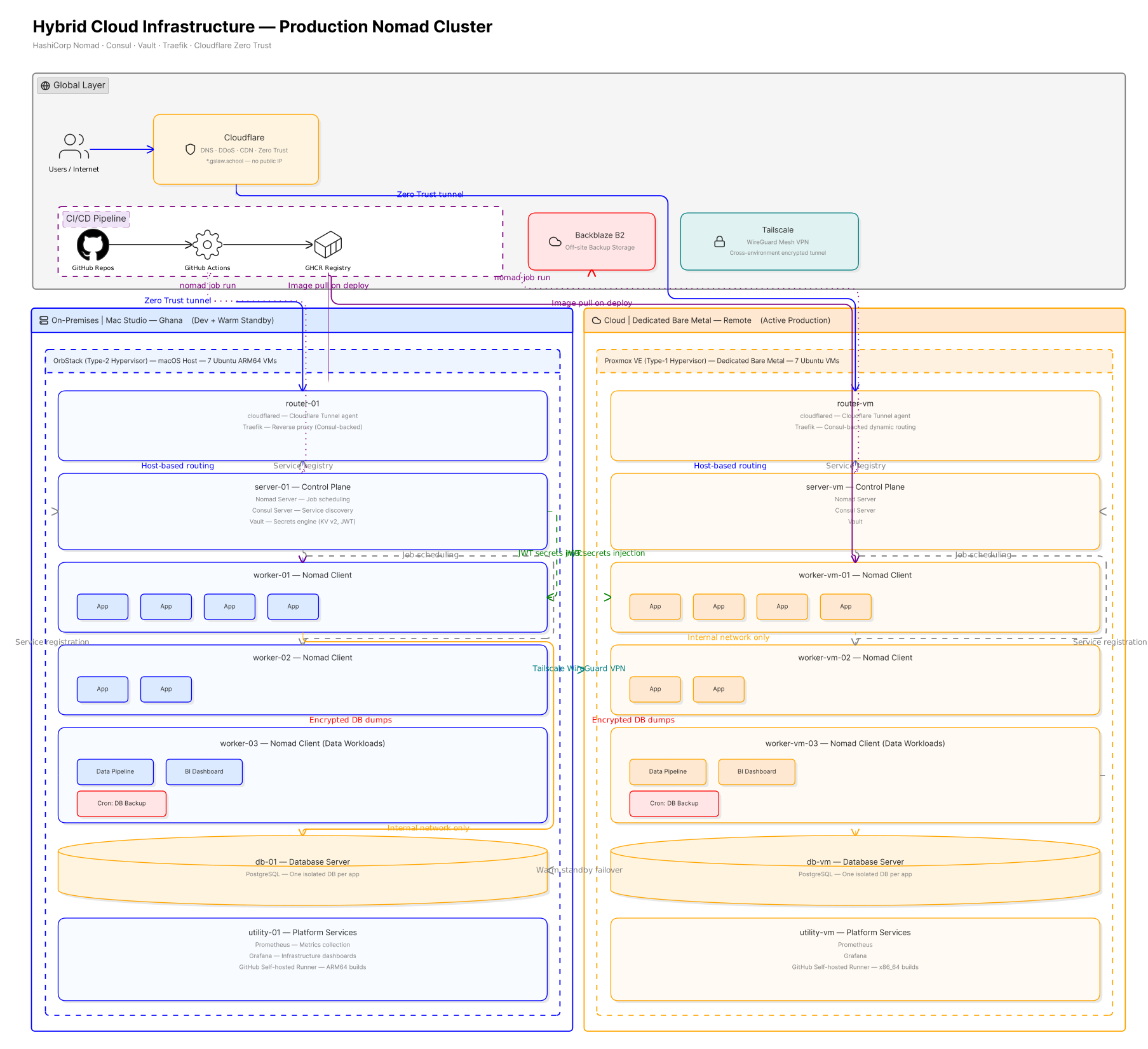
Production Nomad Cluster
Summary
A ground-up platform engineering project for Ghana School of Law: designing and operating a production-grade hybrid Nomad cluster that eliminated manual deployments, removed all secrets from repositories, and cut build times by 16×. The platform runs 10+ services across two physical locations with zero open ports.
Project Snapshot
My Role
Sole Platform & DevOps Engineer
Duration
2.5 months · 2025
Context
Ghana School of Law
Outcome
10+ workloads · 2 locations · zero open ports · 16× faster builds
Stack
The Problem
Context
Ghana School of Law had no formal infrastructure. Applications ran on ad-hoc servers, deployments were manual SSH sessions, and secrets were hardcoded in environment files or committed directly to repositories.
The Pain
Every deployment was a manual SSH session. Secrets lived in plaintext files. There was no way to know a service was down until users complained. A single hardware failure would have taken every digital service offline with no recovery plan.
Why It Mattered
The school runs 10+ production services (student portal, HR system, records management, and internal tools) serving hundreds of students and staff daily. Downtime directly impacts enrollment, examinations, and day-to-day administration.
Goals & Requirements
Technical Goals
- Zero public IP exposure, with all traffic through Cloudflare Zero Trust tunnels
- Zero secrets in repositories, environment files, or Docker images
- Automated deployments on merge to main, no manual SSH required
- Daily off-site database backups with verified restore capability
- Service health visibility via dashboards
- Warm standby across two physical locations, with an RTO under 30 minutes
Constraints
- No budget for managed cloud; it must run on the existing Mac Studio plus low-cost bare metal
- Single engineer, so it must be fully operable and recoverable by one person
- Existing applications must migrate with zero downtime
- ARM64 on-premises (Mac Studio) vs x86_64 cloud, so multi-architecture builds are required
Architecture Design
A hybrid two-location Nomad cluster with a shared HashiCorp control plane (Nomad + Consul + Vault), zero-trust ingress via Cloudflare tunnels, and GitOps-style deployments through GitHub Actions. No port is ever opened on either server; all traffic flows outbound through Cloudflare. The Mac Studio runs the dev environment and the warm standby; OVH bare-metal runs staging and active production.
Scroll horizontally on smaller screens to view full diagram
Component Breakdown
HashiCorp Nomad
Job scheduler that runs all 10+ production workloads as Docker containers with health-checked routing
HashiCorp Consul
Service discovery and health checking. Traefik reads the service registry dynamically, so there's no manual routing config
HashiCorp Vault
Centralized secrets engine: KV v2 for static secrets, JWT workload auth so containers never hold static credentials
Traefik
Reverse proxy that dynamically routes traffic based on Consul service registrations and handles TLS termination
Cloudflare Zero Trust Tunnel
Public ingress via an outbound-only persistent connection, with no inbound ports open on either server
GitHub Actions + GHCR
CI/CD pipeline that builds multi-arch Docker images, pushes to GHCR, triggers Nomad job updates on merge to main
OrbStack (Mac Studio)
Type-2 hypervisor on macOS running 7 Ubuntu ARM64 VMs that mirror production exactly as a warm standby
Proxmox VE (OVH)
Type-1 hypervisor on bare metal running 7 Ubuntu x86_64 VMs as the active production environment
Key Design Decisions
→Nomad over Kubernetes
Single-engineer operation requires simplicity. Nomad has no etcd, no separate control plane complexity. A K8s cluster would take days to recover from scratch; Nomad takes hours. The operational overhead difference is night and day at this scale.
→Cloudflare Zero Trust over VPN or open ports
Zero public IP means zero attack surface. Traditional setups require open ports or a cloud load balancer, and both add cost and risk. Cloudflare tunnels are free, outbound-only, and survive NAT and firewalls. Perfect for a hybrid setup where the on-prem node sits behind a home router.
→HashiCorp Vault over cloud secrets managers
Self-hosted means no AWS dependency for secrets. Vault's JWT workload auth means containers never see a static credential. They authenticate at startup and receive exactly what they need for that run. Eliminates the entire class of 'credentials leaked in logs' incidents.
→OrbStack for on-premises VMs
Mac Studio + OrbStack gives ARM64 VMs with near-native performance at zero cost. OrbStack is dramatically faster and lighter than VMware Fusion. The warm standby mirrors production exactly: same VM count, same job specs, same config.
Implementation Breakdown
Infrastructure as Code
All Nomad job specs, Consul service definitions, and Vault policies are version-controlled as HCL. The entire cluster state is reproducible from the repository.
- One Nomad HCL job spec per service, parameterized with an image tag variable
- Vault policies defined as code, least-privilege scoped per workload identity
- Consul service definitions co-located with job specs
- Bootstrap Bash scripts for new node provisioning; a full cluster from scratch takes under 2 hours
job "api-server" {
  datacenters = ["prod"]
  type        = "service"

  group "app" {
    task "server" {
      driver = "docker"

      config {
        image = "ghcr.io/org/api:${var.image_tag}"
      }

      vault { policies = ["api-server-policy"] }

      template {
        data        = <<EOH
{{ with secret "kv/data/api-server" }}
DB_PASSWORD={{ .Data.data.db_password }}
REDIS_URL={{ .Data.data.redis_url }}
{{ end }}
EOH
        destination = "secrets/.env"
        env         = true
      }
    }
  }
}CI/CD Pipeline
GitHub Actions builds multi-architecture Docker images on self-hosted runners, pushes to GHCR, and triggers Nomad job updates on merge to main. Zero manual steps.
- Multi-stage Docker builds reduced image sizes 60–80% and eliminated bloated layers
- Shared base-image strategy cut redundant dependency installation across every service
- Self-hosted ARM64 runner on Mac Studio for on-prem builds
- Self-hosted x86_64 runner on OVH for production builds
- GitOps: merge to main → automatic deploy, or push a new git tag → automatic deploy, no manual SSH, ever
name: Build & Deploy
on:
  push:
    branches: [main]

jobs:
  deploy:
    runs-on: [self-hosted, linux, ARM64]
    steps:
      - uses: actions/checkout@v4

      - name: Build & push image
        run: |
          docker build -t ghcr.io/org/api:${{ github.sha }} .
          docker push ghcr.io/org/api:${{ github.sha }}

      - name: Deploy to Nomad
        run: |
          nomad job run \
            -var="image_tag=${{ github.sha }}" \
jobs/api.nomadZero Trust Networking
All public traffic routes through Cloudflare Zero Trust Tunnels; no port is open on either server. Traefik handles TLS termination and dynamic routing populated from the Consul service registry.
- cloudflared runs as a Nomad service on the router VM in each environment
- Traefik reads routes from Consul, so no manual config is needed when a new service starts
- All *.gslaw.school domains route through Cloudflare, with zero direct IP exposure
- Internal service-to-service traffic uses the Consul service mesh, no hardcoded IPs
Secrets Management
HashiCorp Vault eliminated all plaintext secrets. Containers authenticate via JWT at startup and receive exactly the credentials they need, nothing more.
- KV v2 engine for static secrets: database passwords, API keys, third-party tokens
- JWT workload auth, where each Nomad job carries a unique identity token scoped to its policy
- Vault policies enforce least privilege; the api-server cannot read database admin secrets
- Zero secrets in .env files, Docker images, CI/CD logs, or git history
Observability & Backups
Prometheus and Grafana provide cluster-wide metrics visibility. Automated nightly PostgreSQL dumps ship encrypted to Backblaze B2 via Nomad periodic jobs.
- Prometheus scrapes Nomad, Consul, and application health metrics
- Grafana dashboards for cluster health, job status, and resource utilization
- Nomad periodic job runs pg_dump nightly, encrypts output, ships to Backblaze B2
- Every production database covered, with restores tested and verified monthly
Challenges & Solutions
#1Multi-architecture builds: ARM64 on-prem vs x86_64 in cloud
The Problem
The Mac Studio uses Apple Silicon (ARM64). The OVH bare-metal server is x86_64. Docker images built for one architecture won't run on the other. Initial CI builds either failed on the wrong runner or took 4+ hours using QEMU emulation for cross-compilation.
The Fix
Added a self-hosted GitHub Actions runner on each machine: ARM64 on Mac Studio, x86_64 on OVH. Each runner builds images only for its native architecture. Introduced a shared base-image strategy to eliminate redundant dependency installation. Build times dropped from 4+ hours to under 15 minutes.
#2Vault bootstrap: the chicken-and-egg unseal problem
The Problem
Vault needs to be initialized and unsealed before any service can fetch secrets. But the unseal keys are themselves sensitive. During initial bootstrap, a single wrong step can lock you out of the entire secrets engine, and recovering from a sealed Vault in production is a stressful, manual process.
The Fix
Documented the bootstrap sequence step-by-step with explicit checkpoints. Stored encrypted unseal key shards in a secure offline location separate from the cluster. Wrote a health-check script that alerts within 60 seconds if Vault becomes sealed unexpectedly. Bootstrap is now a 15-minute repeatable process any engineer can follow.
#3Consul health check race conditions on rolling deploy
The Problem
During rolling deploys, Traefik would briefly route traffic to containers that hadn't finished starting up, causing intermittent 502 errors. Consul health checks were registering services as healthy before the application was truly ready to serve traffic.
The Fix
Added startup health-check grace periods in Nomad job specs and tightened Consul check intervals from 30s to 5s with a 3-failure deregistration threshold. Implemented TCP health checks alongside HTTP. A service must pass both before Traefik routes to it. 502 errors dropped to zero on the next deploy.
Results & Impact
The platform transformed Ghana School of Law from ad-hoc manual deployments to a fully automated, observable, and secure production infrastructure, all operated by a single engineer.
Before → After
Build Time
Deployment Process
Secrets Exposure
Public Attack Surface
Database Backups
Recovery Time
Business Outcome
The school ships updates to production in under 15 minutes with confidence. A hardware failure on either location can be recovered from in under 30 minutes by promoting the standby. The platform has been running without incident since launch.
Reflections
Would Do Differently
- 01Automate the Vault unseal process from day one. The manual unseal step is the only part of the cluster not fully automated, and it's a single-engineer dependency I want to eliminate
- 02Add Nomad Autoscaler earlier. Scaling is currently manual, which means keeping capacity headroom in my head at all times
- 03Implement structured JSON logging from day one rather than retrofitting. Adding log aggregation to services not built with it is significantly harder
Key Takeaways
- 01Zero Trust networking is not a 'nice to have' for a single-engineer shop. It's the only way to secure a multi-location cluster without a dedicated network team or a cloud VPN budget
- 02Nomad's simplicity is a genuine engineering advantage, not a compromise. A midnight cluster recovery drill confirmed that a self-hosted Nomad cluster is recoverable by one person in under an hour
- 03The shared base-image strategy was the single highest-leverage CI optimization. One change simultaneously cut build times across every service in the cluster
Next Project
Airflow ETL & Backup Pipeline
Data Infrastructure